Google Ads Quality Score: What It Is and How to Improve It
Quality Score directly affects how much you pay and where your ads appear. Learn what the three components are, how they work, and how to improve each one.
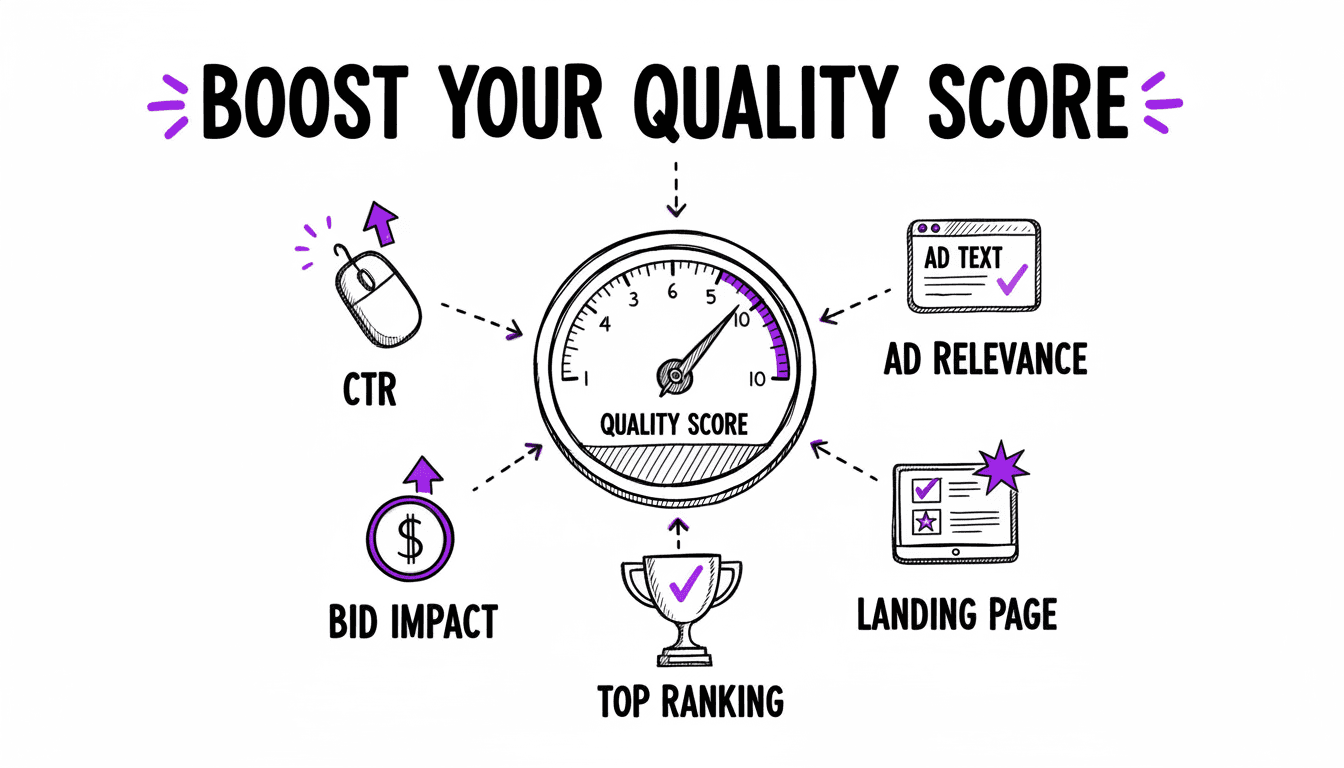
What Is Quality Score?
Quality Score is Google's rating of the quality and relevance of your keywords, ads, and landing pages. It is measured on a scale from 1 (worst) to 10 (best) and is reported at the keyword level.
Quality Score is not just a vanity metric. It directly determines two things:
- Whether your ad shows at all. Low Quality Scores can prevent your ad from entering the auction.
- How much you pay per click. Higher Quality Scores reduce your actual CPC, sometimes dramatically.
Google uses Quality Score as part of the Ad Rank formula:
Ad Rank = Max CPC × Quality Score (+ expected impact of extensions)
This means an advertiser with a €2.00 bid and a Quality Score of 8 (Ad Rank: 16) outranks an advertiser with a €3.00 bid and a Quality Score of 4 (Ad Rank: 12). The first advertiser gets a better position and pays less per click.
The Three Components
Quality Score is made up of three components, each rated as "Above average", "Average", or "Below average":
1. Expected Click-Through Rate (CTR)
Google predicts how likely your ad is to be clicked when shown for this keyword. This is based on your keyword's historical performance, normalized for ad position.
What affects it:
- The relevance of your ad copy to the keyword
- Your historical CTR for this keyword
- The overall CTR performance of your account
How to improve it:
- Include the keyword in your headlines. This is the single most impactful factor. When someone searches "emergency plumber london" and your headline says "Emergency Plumber London", the relevance connection is immediate.
- Use compelling CTAs. "Get a Free Quote", "Book Now", "Call 24/7". Give people a reason to click.
- Differentiate from competitors. Use unique selling points that stand out in a sea of similar ads.
- Use all 15 headline slots. More headlines give Google more options to find high-CTR combinations.
2. Ad Relevance
Google evaluates how closely your ad matches the intent behind the keyword. This is text-matching and semantic analysis. Does your ad actually talk about what the person searched for?
What affects it:
- Whether the keyword appears in your ad headlines and descriptions
- Whether the overall ad messaging relates to the search intent
- The specificity of your ad group structure
How to improve it:
- Tighter ad groups. One keyword theme per ad group means your ad can be precisely tailored to that theme.
- Keyword-specific ad copy. Write ads that directly address the keyword's intent, not generic company descriptions.
- Match intent, not just words. If someone searches "buy running shoes", your ad should sell running shoes, not talk about your brand history.
3. Landing Page Experience
Google assesses the quality and relevance of the page users land on after clicking your ad. This includes content relevance, usability, and page speed.
What affects it:
- How relevant the landing page content is to the keyword and ad
- Page load speed (especially on mobile)
- Mobile-friendliness
- Navigation clarity and trust signals (HTTPS, privacy policy, contact info)
- Content quality and originality
How to improve it:
- Match the landing page to the keyword. If someone clicks an ad for "emergency plumber london", they should land on a page about emergency plumbing in London, not your homepage.
- Use keyword-specific landing pages. Assign each keyword a
landing_paththat leads to the most relevant page. - Optimize page speed. Google PageSpeed Insights is your tool. Aim for 90+ on mobile.
- Mobile-first design. More than half of searches happen on mobile. Your landing page must work flawlessly on small screens.
The Granularity Principle
The underlying principle behind a high Quality Score is granularity. The more precisely your ad and landing page match the keyword, the higher your score. This applies to all three components:
| Component | Generic approach | Granular approach |
|---|---|---|
| Expected CTR | One ad for 50 keywords | Tailored ad per keyword theme |
| Ad Relevance | "We offer services" | "Emergency Plumber London, 24/7" |
| Landing Page | Homepage for all keywords | /emergency-plumber-london |
The problem is obvious: building granular campaigns manually does not scale. Writing unique ads for 500 ad groups, setting keyword-specific landing pages for each one, and maintaining all of this over time is an enormous time investment.
This is the trade-off most advertisers face: quality or scale, pick one. Those who choose scale create broad, generic ad groups with mediocre Quality Scores. Those who choose quality limit themselves to a handful of meticulously crafted ad groups.
Granularity at Scale, Without the Manual Work
WonderAds builds the exact structure that Quality Score rewards. Variable templates like 'Best {{lists.services}} in {{lists.locations}}' generate unique, keyword-tailored ads for every ad group. Each keyword gets its own Final URL via landing paths. Hundreds of precisely targeted ad groups, generated in minutes.
Quality Score Optimization Strategies
Strategy 1: Restructure Your Ad Groups
If your ad groups contain keywords with different intents, split them. A good rule of thumb: if you cannot write one ad that is highly relevant to every keyword in the group, the group is too broad.
Before:
- Ad group "Plumbing" → plumber, plumbing services, drain unblocking, boiler repair, bathroom renovation
After:
- Ad group "Plumber London" → plumber london, london plumber
- Ad group "Drain Unblocking" → drain unblocking london, unblock drain london
- Ad group "Boiler Repair" → boiler repair london, london boiler repair
For more on this, read our guide on Google Ads account structure and SKAGs.
Strategy 2: Keyword-Specific Ad Copy
Once your ad groups are tight, write ads that directly reference the keyword. The easiest way: include the keyword in Headline 1 and pin it to position 1.
For the "Drain Unblocking" ad group:
- Headline 1 (pinned to position 1): "Drain Unblocking London"
- Headline 2: "Fast Same-Day Service"
- Headline 3: "No Call-Out Fee"
Strategy 3: Landing Page Alignment
Map each ad group to a landing page that matches the keyword's topic. The URL path should reflect the service:
- "plumber london" → example.com/plumber-london
- "drain unblocking" → example.com/drain-unblocking
- "boiler repair" → example.com/boiler-repair
This alignment boosts Landing Page Experience and reinforces Ad Relevance.
Strategy 4: Improve Your CTR Mechanically
Beyond ad relevance, there are structural optimizations that lift CTR:
- Ad extensions. Sitelinks, callouts, and structured snippets increase ad size and visibility.
- Headline diversity. Use all 15 headline slots across different message categories (keyword match, benefits, CTAs, trust signals).
- Test continuously. Replace underperforming headlines every 4-6 weeks based on the Combinations Report.
Strategy 5: Monitor and Iterate
Quality Score is not static. It evolves as Google gathers more data on your keywords and ads.
- Check Quality Scores weekly for your top-spending keywords.
- Segment by the three components. If Expected CTR is "Below average" but Landing Page Experience is "Above average", focus on ad copy improvements.
- Track changes over time using the Quality Score History column in Google Ads.
Quality Score Myths
"Quality Score directly determines my CPC"
Not quite. Quality Score determines your Ad Rank, which affects the position you get and the minimum CPC you need to maintain that position. The actual CPC you pay is based on the Ad Rank of the advertiser below you.
"I need a 10/10 on every keyword"
A Quality Score of 7-8 is excellent for most keywords. Getting from 8 to 10 often requires disproportionate effort for marginal gain. Focus on lifting your below-5 keywords first. That is where the biggest CPC savings are.
"Quality Score updates immediately"
Quality Score updates periodically, not in real time. After making changes, allow 1-2 weeks for the score to reflect your improvements. Do not panic if it does not move immediately.
Related Articles
Build Quality Score-Optimized Campaigns
WonderAds creates the campaign structure that Google rewards: tightly themed ad groups, keyword-specific headlines via variables, per-keyword landing pages, and proper match type management. Better Quality Scores mean lower CPCs and higher ad positions.
Get Started with WonderAdsRelated Articles
Single Keyword Ad Groups (SKAGs): How to Maximize Your Google Ads Performance
Master the SKAG strategy to boost Quality Score, lower CPC, and get more relevant clicks. Step-by-step guide to Single Keyword Ad Groups.
Read articleGoogle Ads Account Structure: How to Build Your Account the Right Way
Learn the optimal Google Ads account structure with campaigns, ad groups, and keywords. Discover how proper organization lowers your CPC and improves Quality Score.
Read articleHow to Turn Off Auto-Applied Recommendations in Google Ads (2026)
Google Ads can change keywords, bids and ads on its own. Learn what auto-applied recommendations do, when they help, and how to switch them off.
Read article